The Pigeons of Santa Maria Nascente

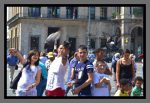
In the center of Milan is the Cathedral of Santa Maria Nascente also known as the Milan Cathedral and Il Duomo Milano. It seems that outside every major european cathedral you will find a group of pigeon Handlers and peddlers selling corn or pigeon food to tourists. I personally don’t touch pigeons, although I have eaten a couple. I worry about disease and such. In this picture you can see a spectrum of human emotions; fear, excitement,wonder and terror. You can buy a print of this on my commercial gallery by clicking here.

flight

Pigeon People

If Looks Could Kill

t was a very hot afternoon in Milan Italy. The sun was relentless and around 3 PM we headed back to our hotel after a rough day of touring. As we neared the Westin Palace Milano we came across a fashion photography shoot on the street. The crew was yelling at each other, maybe because of the heat or maybe just ineptitude. The model looked hot, flabbergasted and near passing out as she waited for the photographer. Last week I posted what I thought was the best of this series . However, I like this one also because her facial expression shows how she really feels about the whole situation. You can buy a print of this image at my commercial site by clicking here.

iflookscouldkill

The Model and the Cyclist

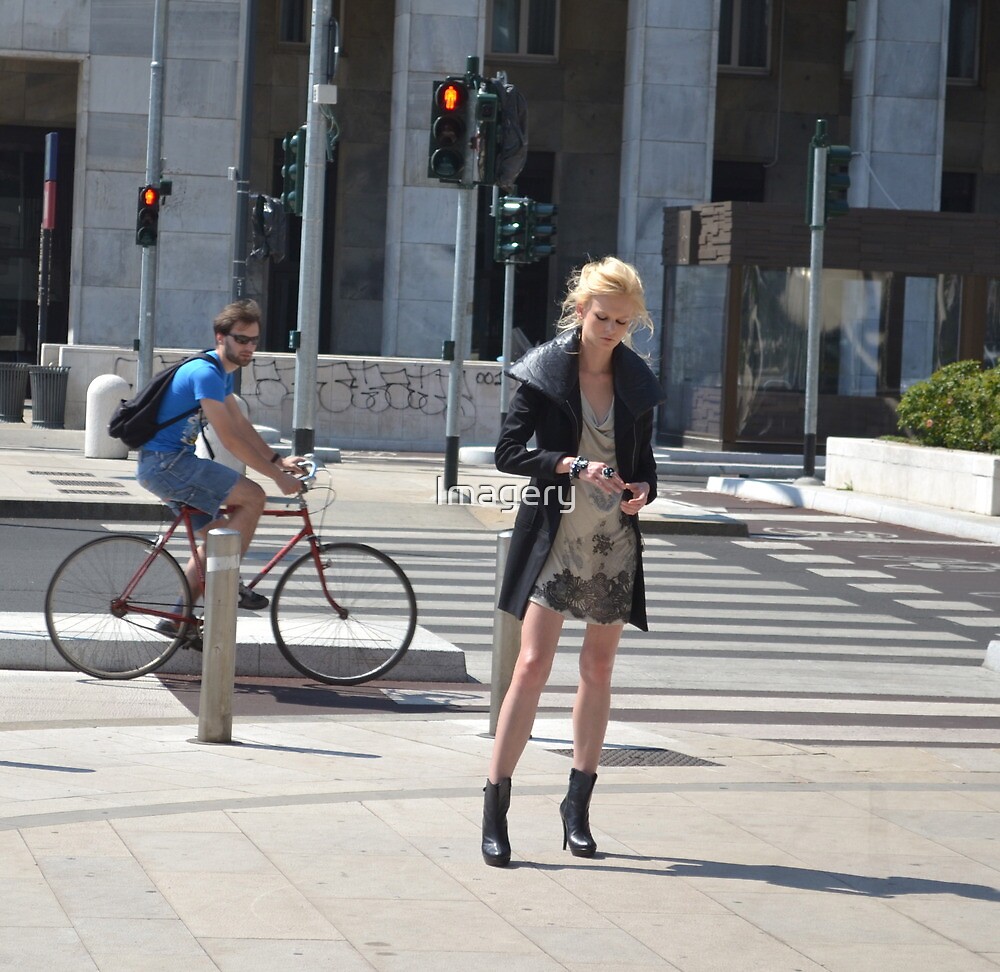
It was a very hot afternoon in Milan Italy. The sun was relentless and around 3 PM we headed back to our hotel after a rough day of touring. As we neared the Westin Palace Milano we came across a fashion photography shoot on the street. The crew was yelling at each other, maybe because of the heat or maybe just ineptitude. The model looked hot, flabbergasted and near passing out as she waited for the photographer. This gave me an opportunity to jump in front of the crew and get about 5 shots. This is the best one and you can purchase a copy of this image at my commercial site by clicking here.

themodelandthecyclist

The Model and the Cyclist

Graffiti and the Girl

While traveling through Italy last year I was stunned by the amount of graffiti. It was everywhere except churches. I did not see any church with graffiti and some areas had more than others. Some were wonderful works of art and some just gang signs. The other thing I noticed were a plethora of beautiful,fit and well dressed women. I felt most people in europe are in better shape than most Americans. This may come from walking and bike riding instead of driving. With gasoline at over $10 per gallon, most people walk and take public transportation. This image was taken in Milan near Il Duomo. You can buy a print of this image at my commercial gallery by clicking here.

Graffiti and Girl

Graffiti and Girl

Old School Montréal

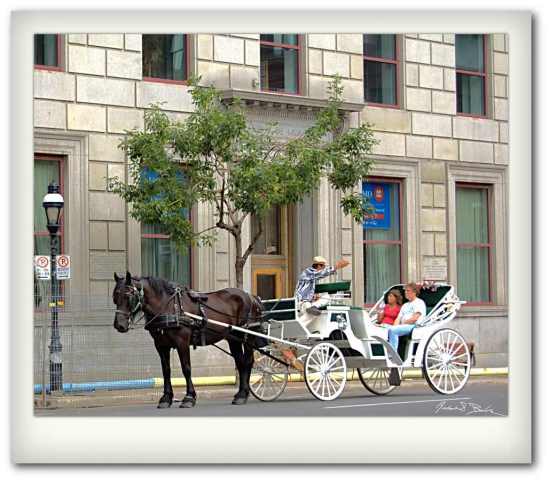
Québec has two major cities, Québec (City) and Montréal. When we first visited the provence of Québec, we went to Québec city because we wanted to see old French Canada. We then traveled to Montréal specifically to see the Jazz festival and we stayed in a modern high rise hotel. To our surprise, Montréal also has a wonderful old city which rivals Québec in history and European flavor. A good way to see the old city is to take a ride in a horse drawn carriage like these tourists. You can buy a print of this image on my commercial site by clicking here.

Horse and Driver in Montreal

Horse and Driver in Montreal

Using the Zone System in Photography

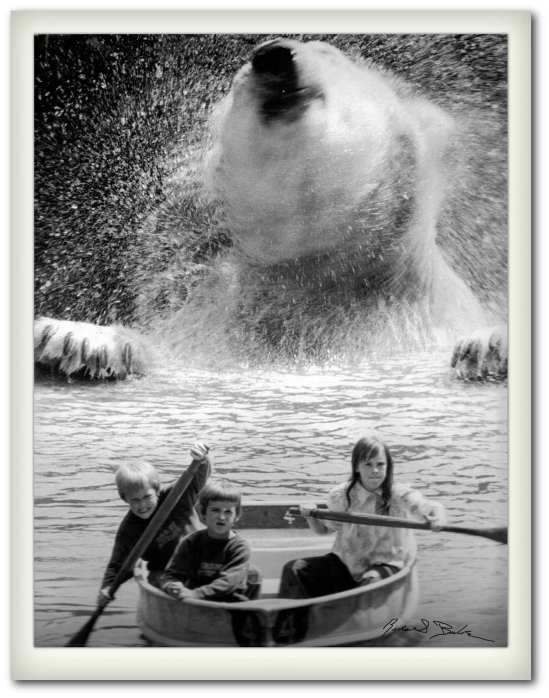
The Zone System is a photographic technique invented by Ansel Adams and Fred Archer in 1941. At the time, most Photography was monochromatic and Adams worked out a system for visualization, which he considered to be a creative technique. He believed that you should look at a scene and visualize how you want the tones to look in the image. From that point he could apply exposure science to get the perfect exposure on film. Musicians say that if you can hum a tune, you can play it. Ansel Adams believed that if you could visualize the image you could photograph it. The Zone System provides photographers with a method of defining the relationship between the way they visualize the photographic subject and the final results. Although it originated with black and white film, the Zone System is also applicable to black and white and color, negative and reversal, and digital photography. The zone system is still taught today in photography schools and is a relevant tool for digital and film photography and for color and monochrome images. The image below is a good illustration of the zone system and you buy a print of this award winning image at my commercial gallery by clicking here.

Row for Your Life!

Row for Your Life!

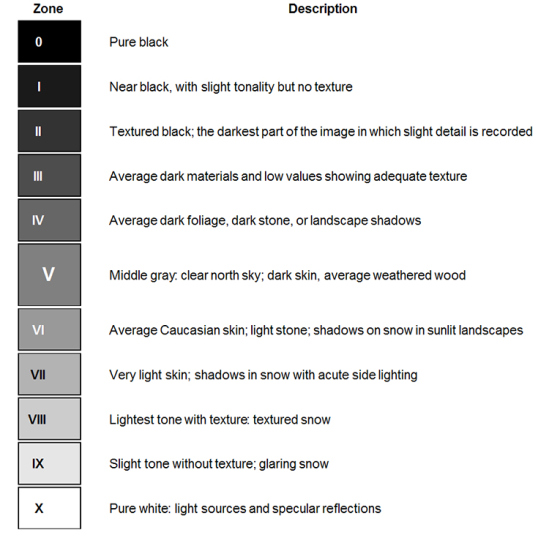
The simple tool that Adams and Archer developed is this 11-point monochromatic strip ranging from Step 0 to Step 10. Adams and Archer discovered that the eleven zones could be corresponded to exposure values. Exposure values refer to the logarithmic relationship between Aperture, Shutter Speed and Sensitivity. Sensitivity is the film or sensors ability to record light. In his book “The Negative” published in 1948 Adams discusses the scientific relationship between exposure value and the Zone System allowing Photographers to calculate how to adjust exposure to compress or expand the zones. Again, this all ties into visualization and knowing how you want tones to be reproduced.

Zone System Gradient lines

Zone System Gradient lines

To aid Photographers in visualization, Adams developed descriptions for each Zone. Keep in mind that the zone system strip is positive but Adams was working with negatives. The pure black of Zone 0 means that the negative was completely clear. This guide is just as relevant today as it was 70 years ago in helping photographers visualize photographic situations. Knowing that a person with light skin is Zone VII and that my meter is balanced for Zone VI tells me I need to close down one stop to achieve the optimum exposure for their skin. Keep in mind light meters today are much more sophisticated then 70 years ago and it is important to understand the operation of your light meter. In any case a light meter will not help you visualize a scene but the zone system will.

Zone System Descriptions

Zone System Descriptions

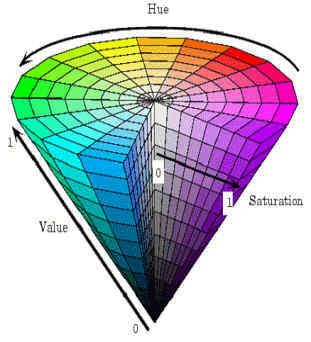
Although the Zone System was developed for monochrome images it can be applied to color photography as well. Keep in mind that device independent color models like HSV are based on hue, saturation and value. Value refers to the light/dark part of the color and when combined with saturation control the density of the image. The logarithmic part of exposure value applies here and so does the zone system. The greater the value, the less detail will be displayed in the image. It is more complicated than monochrome for sure but not when applied to visualization. Try visualizing your subject in monochrome and apply the zone system to that visualization. Many photographers and cinematographers carry a viewer that subtracts color from the scene. This allows them to make initial lighting an exposure decisions before considering the color elements.

Indexed Color Model

Indexed Color Model

Being A Photojournalist

Being a Photojournalist

Photojournalism usually refers to a type of journalism where the picture is used to tell a story or express a position. When I first started in Photography it was the only thing I really wanted to do. Even back then it was tough to make a living as a photojournalist, so I learned how to do other things but my love of Photojournalism never left me. To this day I keep taking photojournalistic images even though nobody is paying me to do it. This one was taken in Paris France last summer. You can buy prints on some of these images on my commercial gallery by clicking here.
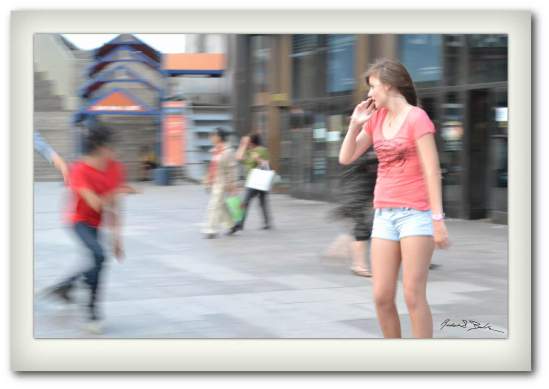
Warm up for Pari Roller

Warm up for Pari Roller

You don’t really need Press Credentials to be a photojournalist, but it sure helps. Since the assassinations of the 1960’s it is more difficult to get close to people and stages. Even in the 1970’s, I could never have gotten close enough to get this photograph of Senator’s McGovern and Kennedy at a Pittsburgh presidential campaign rally without Press Credentials.
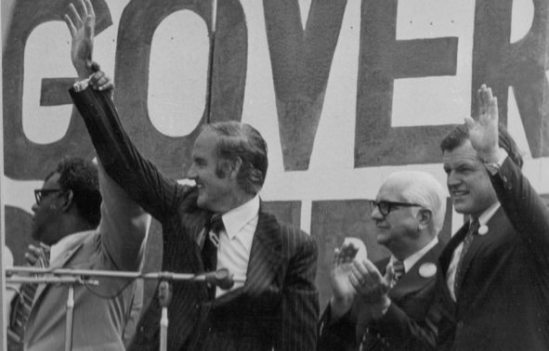
mcgovern

George McGovern and Ted Kennedy 1972

To be a photojournalist you need to be able to work strange and long hours. Like a news reporter you have to be willing to do anything for a story. In 1978, film director George Romero made “Dawn of the Dead” in a local Pittsburgh Shopping Mall. I was assigned to cover the story for Pittsburgh Magazine. Since it was being shot at a shopping mall, it was filmed from 9 PM until 8 AM. I would shoot at night and develop the film and make the prints during the day to be able to make the magazine deadline. This is a shot of George Romero listening to one of the movie’s Producers and trying to stifle a laugh.
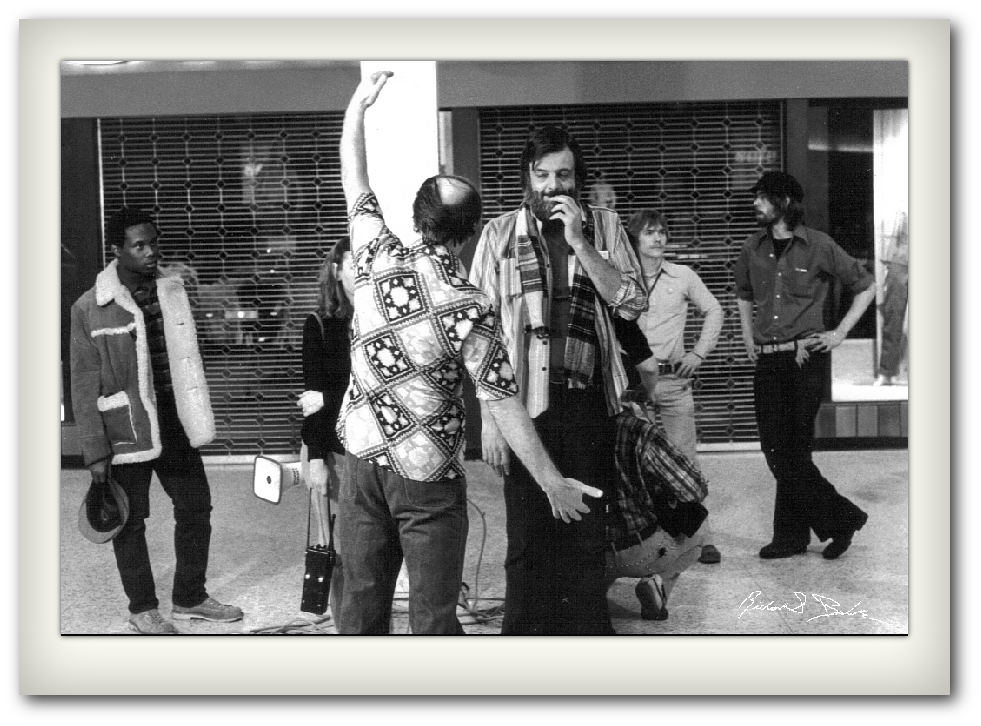
George Romero

George Romero on the Set of Dawn of the Dead

Sometimes the story is not right in front of you. I was assigned to cover the One World Festival of Music in 1972 in Pittsburgh. I was sitting in the stands trying to figure out how to sneak on to the stage. I noticed some people sitting behind me and figured out it was Dino Valente and Gary Duncan from Quicksilver Messenger Service. The band was one of the headline acts that would perform later. I clicked this picture of Dino Valente kissing some unknown blonde which was the best image of the day.

Dino Valenti of Quicksilver Messenger Service

Caught in The Act

Capture the moment. Henri Cartier-Bresson was the famous French Photojournalist which developed the idea that for each image there is one correct moment of capture and only one. This picture was taken at a high school football championship game and I think illustrates that point. The facial expressions all have the one pure moment of victorious joy and the pat on the derriere offers the exclamation point on the moment. Bracket your exposures and take multiple exposures to make sure you capture the defining moment.
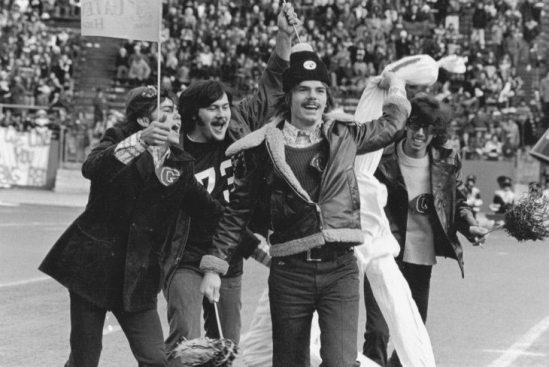
wpialchampionship74

WPIAL Championship 1974

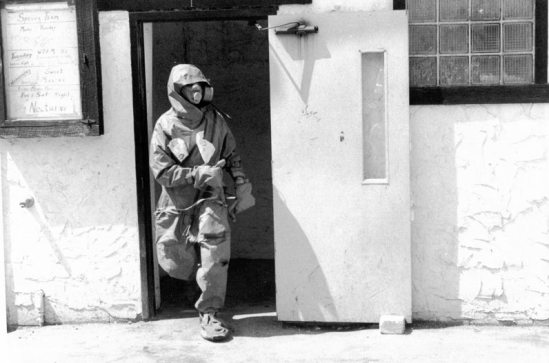
Always take pictures of the weird stuff you may see. One might think that this is some sort of worker in a radiation suit involved in some nuclear or chemical accident. The reality is quite different. This person was participating in a race that used to happen every spring at Penn State University. People would have to run a mile and drink six beers at six different bars along the run. Participants would dress in weird costumes and the money was donated to charity. The event was eventually cancelled because the University and the town councils thought in promoted public drunkenness
phisi500

Bill and Stanley

Stanley Clarke and Billy Cobham at the Stanley Theather in Pittsburgh during the 1970’s. This was taken during the School Days tour. To buy a print of Stanley Clarke on my commercial gallery click here.

School Days

Stanley Clarke, Billy Cobham at the Stanley Theather

Stanley Clarke at the Stanley Theather

Another image of Stanley Clarke at the Stanley Theather in Pittsburgh during the 1970’s. This was taken during the School Days tour. To buy a print of Stanley Clarke on my commercial gallery click here.

Stanley at the Stanley

Stanley at the Stanley